
01
Clear services
Name each service in the language customers use. Explain who it is for, what happens and what the customer gets.
AI SEO for small business means making your website, services, business information and proof easier for Google and AI-powered search systems to understand when customers ask relevant questions.
You do not need to become an SEO expert or buy a complicated tool stack. Start by making the business clearer, the website more useful and the important information easier to verify.

The short answer
It is the practical work of making a small business easier to discover and understand across normal search and AI-powered search.
That includes clear service pages, accurate business details, crawlable pages, direct answers to customer questions, genuine reviews or proof, useful local information and consistent contact details. AI tools can help with parts of the work, but they do not replace business knowledge or human review.
How it works
The website should clearly explain the business before expecting a search engine or AI system to explain it correctly.
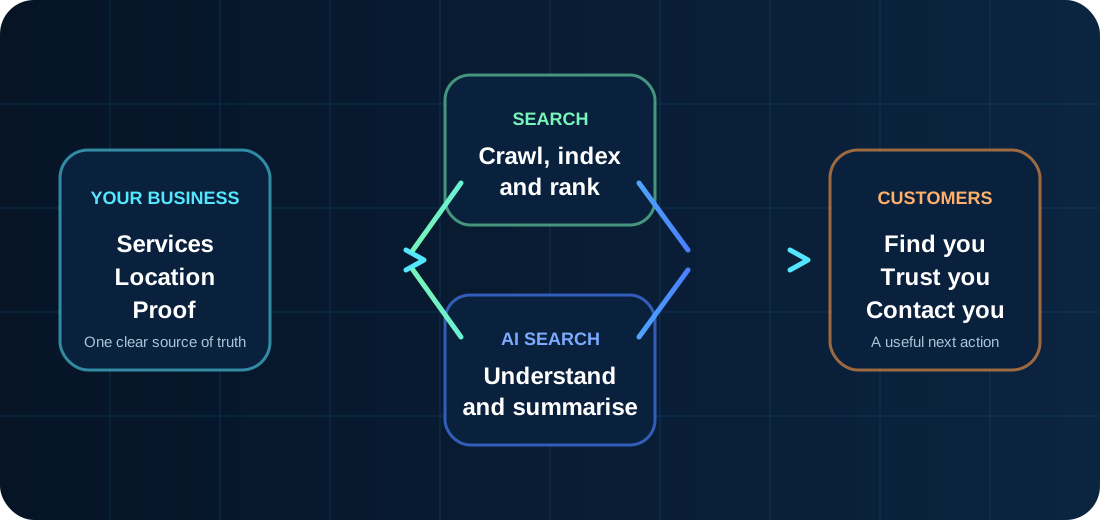
The foundations
Large competitors may have bigger budgets. A small business can still produce more specific, useful and trustworthy information about its real customers and work.
Name each service in the language customers use. Explain who it is for, what happens and what the customer gets.
Keep the business name, website, contact details, service area and opening information consistent wherever customers see them.
Use calls, emails, DMs and objections to create pages that answer what people genuinely need before buying.
Show real examples, methods, qualifications, policies, reviews and first-hand experience without inventing proof.
Make important information public, internally linked and accessible without logins or JavaScript-only interactions.
Give a direct answer first, then add context, evidence, limitations and a useful next action.
Use real photos, screenshots, diagrams or short videos when they make the business or process easier to understand.
Track Search Console, enquiries, referral traffic and the pages customers actually use before spending more.
Choose the right path
The foundations overlap, but the buying journey changes what should be improved first.
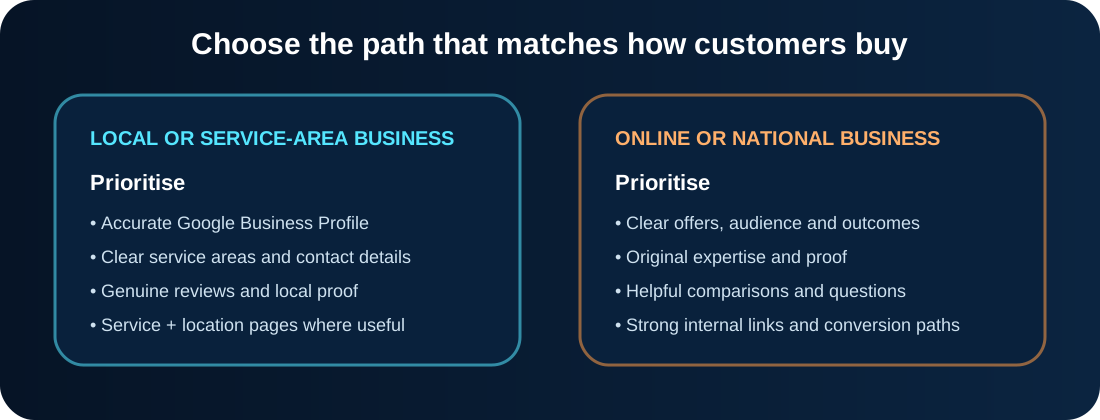
| Business type | Start with | Useful proof | Important pages |
|---|---|---|---|
| Shop, café or venue | Accurate hours, location, products or services, Google Business Profile | Current photos, genuine reviews, menus, availability | Home, location, services/products, contact |
| Tradesperson or service-area business | Service areas, clear jobs handled, phone/contact route | Before-and-after work, qualifications, reviews, policies | Service pages, area information, projects, contact |
| Professional service | Who you help, problems solved, process and boundaries | Credentials, case examples, methods, testimonials | Services, process, about, FAQ, contact |
| Online store or national service | Clear offers, categories, delivery or fulfilment details | Product data, policies, demonstrations, customer experience | Category/product/service pages, comparisons, help content |
Seven-step beginner plan
This plan is designed for a business owner without a marketing team.
Use: “We help [audience] with [service] in [location or market] so they can [outcome].” Put the accurate version near the top of the website.
Use real questions from customers: price, process, timing, suitability, location, risks, comparison and what happens next.
Add a direct definition, who the service is for, what is included, proof, limitations and a clear contact action.
Confirm the business name, phone, website, location/service area, hours and key links are accurate and consistent.
Publish a real project example, process diagram, customer story, demonstration, original photo or expert explanation.
Confirm the page loads on mobile, is internally linked, has a canonical URL, is not blocked and can be inspected in Search Console.
Record what changes, watch Search Console and customer behaviour, then improve the next page based on evidence.
Free and low-cost starting tools
Do not confuse software with strategy
What AI can and cannot do
Question research, outlines, content organisation, rewrite options, checklist creation and first-pass technical explanations.
Business facts, local accuracy, service details, customer insight, evidence, legal claims, tone and final publication decisions.
Reviews, case studies, awards, prices, addresses, qualifications, guarantees, statistics or customer results.
Quick readiness check
Select the statement closest to the current problem. The result is calculated only in your browser and is not stored.
The acronyms, simplified
Small-business owners do not need three separate strategies. Use each label to understand a different part of the same visibility problem.
| Term | Simple meaning | Small-business example | KRONATRIX guide |
|---|---|---|---|
| AI SEO | SEO foundations in an AI-search environment | A clear, crawlable service page with genuine proof | AI.SEO → |
| AEO | Making content useful for direct answers | Answering “How much does this service cost?” clearly and honestly | AEO → |
| GEO | Understanding source visibility in generative search | Publishing information that can be verified and used as a source | GEO → |
| AI Search Optimization | The umbrella view across search and AI experiences | Connecting technical access, content, evidence and measurement | AI Search → |
Frequently asked questions
AI SEO for small business means improving the website and public business information so search engines and AI-powered search experiences can understand what the business offers, who it serves, where it operates and why customers should trust it.
It can be worthwhile when it improves the same foundations customers need: clear services, accurate details, useful answers, genuine proof and easy contact options. It is not worthwhile when it is only mass-produced content or expensive software without a clear business goal.
Yes, particularly by publishing more specific local knowledge, first-hand experience, clearer service information and stronger proof. A small business cannot guarantee rankings, but it can often be more useful and relevant for a narrow customer need.
No. Start with the website, Google Search Console, Google Business Profile when eligible, customer questions and a simple improvement plan. Paid tools may save time later, but they are not the foundation.
ChatGPT can help with research, outlines, drafts and checklists. It cannot replace accurate business facts, customer insight, technical decisions, original evidence or final human review.
Yes. Google says established SEO best practices remain relevant because its generative search features are rooted in core Search ranking and quality systems.
It can support local visibility when the business has accurate information, an eligible and compliant Google Business Profile, useful location or service information, genuine proof and a website that clearly explains the offer.
Useful website improvements can be published quickly, but crawling, indexing, ranking and customer response take time and are not guaranteed. Measure progress over weeks and months rather than expecting an instant result.
No. Each platform controls its own indexing, ranking, source selection and answer generation. An ethical provider should improve the foundations without guaranteeing an outcome it cannot control.
Official guidance
These first-party resources support the recommendations in this guide.
Practical next step
Send KRONATRIX your website, business type and the main customer search or question you care about. We will review the visible foundations and point you toward the most useful next improvements.
KRONATRIX resource network